
The book · Brett Payne
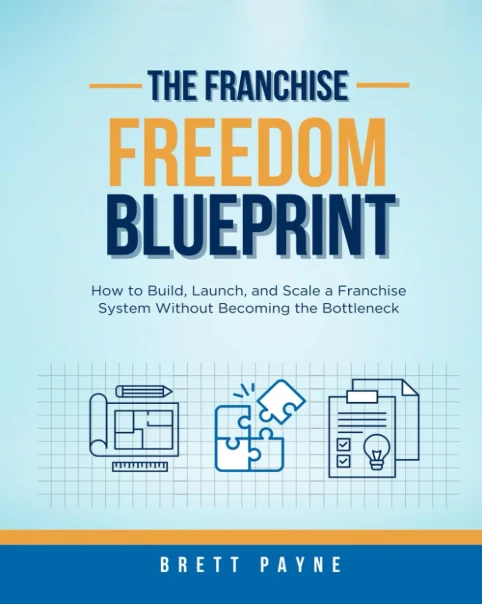
How to Build, Launch, and Scale a Franchise System Without Becoming the Bottleneck
A 326-page guide by Brett Payne for business owners who want to know whether their business can be taught, transferred and run by others — and what it takes to build a franchise system that doesn't depend on them.
By Brett Payne · Paperback · 326 pages · December 17, 2025
What the book teaches
A successful business is not automatically ready to franchise. Before a founder can franchise, they have to develop systems, standards, training, people and operating structures that work without constant personal intervention.
The book presents franchise development as a way to create a more transferable, sustainable business — not simply a way to increase location count. It is written for owners who may never franchise at all: a business built to be replicated depends less on its owner either way.
The Replicability Filter
The book's readiness test: four Filter Stages a business has to pass before anyone should try to replicate it.
- 01
Product Consistency
The same product, delivered the same way, regardless of whose hands are doing the work.
- 02
Process That's Teachable
The way the work gets done is documented well enough to teach, not trapped in the founder's head.
- 03
People Who Can Run It Without You
The question the book keeps returning to: if you stepped away for a month, would the business thrive, survive or collapse?
- 04
The Mindset Shift
The owner's move from operator to builder of a business that is valuable whether or not it is ever franchised.
The Franchise Freedom Blueprint framework
Separate from the Replicability Filter's four Filter Stages, the book's Blueprint rests on three core pillars: product consistency, a teachable process, and people who can run the business without the founder. Once a business passes the Filter, the book (Chapter 3) moves it through four stages of building a franchise system.
Systematize
Get everything out of the founder's head and into documented, repeatable systems: the blueprint someone else can follow.
- Operations manuals
- Training programs
- Standard operating procedures
- Brand standards
- Quality controls
Focus: creating the blueprint.
Validate
Test the systems with someone who is not the founder, and prove they hold up under real-world conditions.
- A non-founder can run a location successfully
- The training actually works
- The systems hold up in practice
- The unit economics are replicable
Focus: proof of concept.
Scale
Build the infrastructure needed to support multiple locations.
- Legal structures such as the FDD and franchise agreement
- Support teams such as field coaches, training specialists and compliance officers
- Technology platforms such as CRM, learning management and dashboards
- Marketing systems for franchise development and consumer demand generation
Focus: building capacity.
Optimize
Refine, improve and evolve the system based on real-world performance.
- KPIs across all locations
- Franchisee feedback
- Customer satisfaction
- Operational efficiency and financial performance
Focus: continuous improvement.
Inside the book
Eight parts and 22 chapters take a founder from the first readiness questions to resale and succession.
Part I
Foundation & Readiness
- 1Is Your Business Ready to Franchise?
- 2Understanding the Economics of Franchising
- 3The Franchise Freedom Blueprint Overview
- 4Building Your Franchise Vision
Part II
Legal & Structural Foundations
- 5Trademark Protection & IP Strategy
- 6Creating the Franchisor Entity
- 7The FDD and Franchise Agreement
Part III
Operations & Training Systems
- 8Building the Operations Manual
- 9Training Architecture That Scales
- 10Technology Infrastructure for Franchising
Part IV
Marketing, Sales & Growth
- 11Franchise Development Marketing
- 12The Franchise Sales Process
- 13Territory Planning & Market Mapping
- 14Building Your Exit Strategy (Even If You Never Want to Leave)
Part V
Managing the Network
- 15Communication Systems & Network Culture
- 16Field Support, Audits & Quality Control
- 17National Marketing Fund & Brand Campaigns
Part VI
Supply Chain, Innovation & Long-Term Scaling
- 18Supply Chain, Vendors & Cost Controls
- 19The Innovation Pipeline
Part VII
Legal Protection, Risk Management & Global Expansion
- 20Legal Risk Management & Enforcement
- 21International Expansion Framework
Part VIII
Exit Strategy & Legacy
- 22Franchise Resale System & Succession Strategy
Three chapters worth starting with
For owners weighing franchise development, these chapters do the most to show what the work involves.
Chapter 1 · Is Your Business Ready to Franchise?
The book's diagnostic chapter. It starts with a simple absence test — what breaks if the founder disappears — and argues that a business its owner cannot leave is a job, not a franchisable asset. It then works through the four Filter Stages of the Replicability Filter, with readiness questions readers answer about their own business.
Chapter 12 · The Franchise Sales Process
A sales process designed to help the right candidate decide well and the wrong one disqualify themselves. Seven stages — Initial Inquiry, Pre-Qualification, Discovery Call, FDD Review and Financial Analysis, Validation Calls, Discovery Day, and Decision and Agreement — built on qualifying early rather than selling hard.
Chapter 22 · Franchise Resale System & Succession Strategy
The closing chapter plans for the day a successful franchisee wants to sell. It explains why a resale system protects the whole network, how to build transferable value into every location from the start, and how to qualify and approve resale buyers.
How the book relates to Brett's other frameworks
Each framework comes from a different source. They complement one another, but they are not the same thing.
Replicability Filter — four Filter Stages for testing whether a business can be replicated; from the book.
Franchise Freedom Blueprint — Systematize, Validate, Scale and Optimize; the book's process for building a replicable franchise system.
Five-step franchise process — Prove Your Model, Systemize Everything, Protect It Legally, Prepare Your Sales Engine and Pilot Launch; from Brett's video How to Start a Franchise.
GROWTH Code — Brett's six-part consulting methodology from his presentations and client work; it is not part of the book.
Book details
- Author
- Brett Payne
- Published
- December 17, 2025
- Publisher
- Independently published
- Format
- Paperback, 326 pages
- ISBN-13
- 979-8261718680
- Language
- English
What to do next
If the book has you asking whether your own business is ready, these are the natural next steps.
Answers
Frequently asked questions
Is your business ready to franchise?
A feasibility review looks at your model, unit economics and systems, and gives you an honest answer.