The Most Expensive Integration in My Business Was Me
How I stopped being the copy-paste button between my own AI tools — and the architecture that replaced me.
A month ago, I was the slowest component in my own technology stack.
I had AI tools everywhere. A chief-of-staff assistant. A second AI I think out loud with. An architect model that designs our software. Builders that write the code. A server full of agents keeping our data current around the clock.
And every one of them could only talk to me.
So my day looked like this: read an answer in one window. Copy it. Paste it into another window. Re-explain the context the second tool never got. Carry its question back to the first window. Repeat. I wasn't leading the system. I was its integration layer — the most expensive, slowest, most error-prone API in the company, and I was billing myself at a founder's rate to do data entry.
That's embarrassing for a guy who wrote a book about removing yourself as the bottleneck. But it's exactly the same disease. A business stalls at the founder in operations. It stalls at the founder in AI, too — the moment every tool routes through you, your tools stop being leverage and start being errands.
The fix wasn't another tool. The fix was an org chart.
Roles, not tools
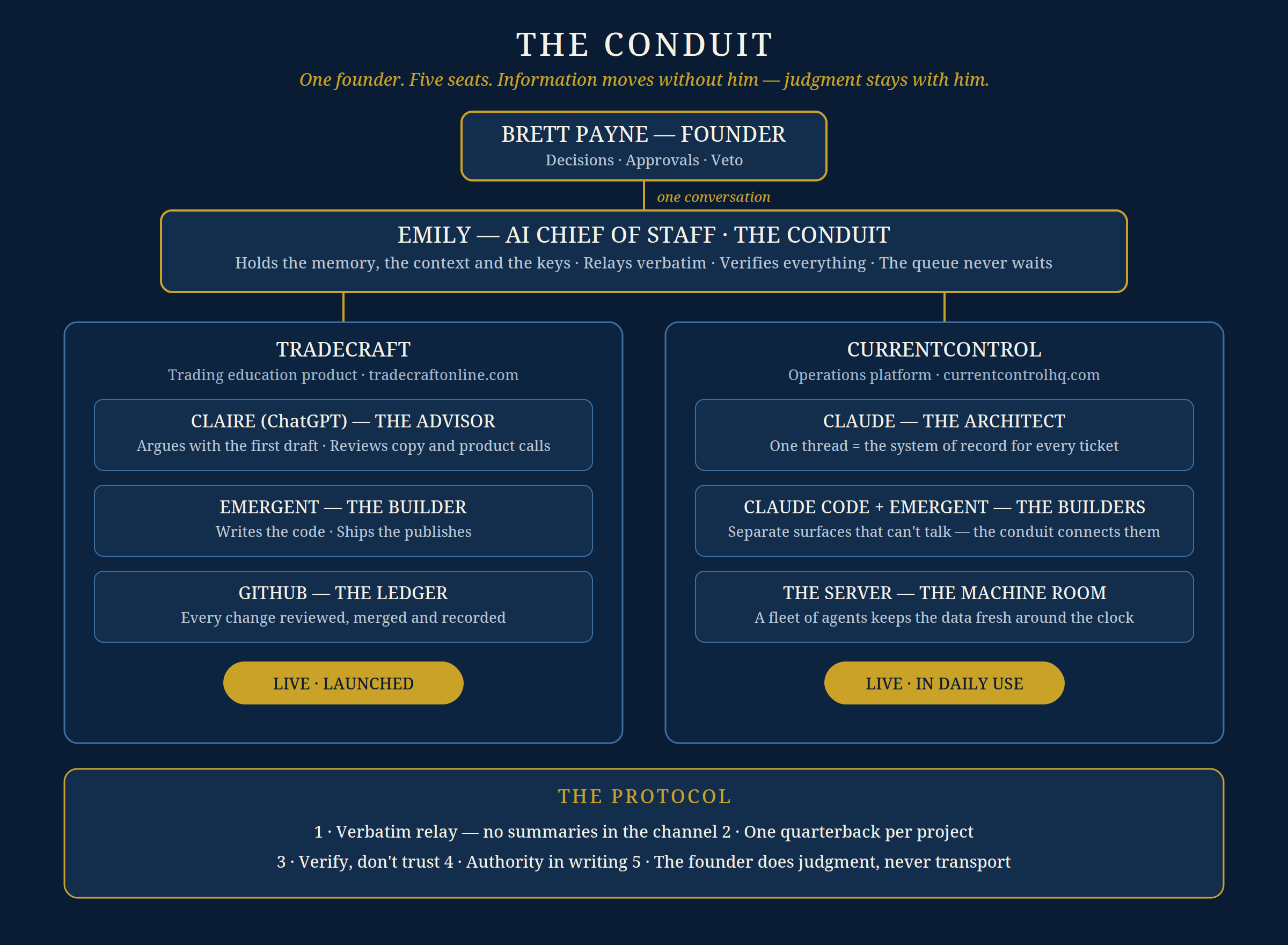
The system that now runs my builds has five seats, and every seat is a role before it's a product:
The Chief of Staff. One AI holds the whole picture — every business, every decision, every rule, every password's location, every open loop. She doesn't just answer questions. She drives: relaying work between the other seats, verifying what comes back, logging into the live product to QA it the way a customer would, and pulling the next item off the queue the moment one finishes. I talk to one seat. She runs the rest.
The Advisor. A second AI, deliberately a different one, whose job is to argue. She reviews product decisions and marketing copy with no loyalty to the first draft. Two weeks ago she caught a real error in how I'd framed my own book's core diagnostic on its sales page. That's the seat paying for itself.
The Architect. For each software project, exactly one running thread is the quarterback and the system of record — every ticket, every spec, every decision lives there and nowhere else. The architect designs the change, assigns it, and verifies the finished diff before anything ships.
The Builders. Code gets written by builder tools working on their own surfaces — surfaces that, notably, cannot talk to each other. Which is the whole point of the next section.
The Machine Room and the Ledger. A private server runs a fleet of small agents that keep our operational data fresh around the clock, and every code change passes through one repository where it's reviewed, merged, and deployed through a single door. No side channels. No mystery versions.
The protocol is the product
Tools are commodities. What makes this work is five rules, and they'd work with any tools:
- Verbatim relay. The chief of staff carries messages between seats word for word — full reports, full questions, no summaries. Summaries are where errors breed, because the summarizer quietly starts deciding. In the channel, she never decides. She conducts.
- One quarterback per project. If it isn't in the system of record, it didn't happen. Two threads of truth is zero threads of truth.
- Verify, don't trust. Every publish gets its diff checked. Every feature gets walked on the live product, as a real user, before it's called done. "The agent said so" is not verification.
- Authority in writing. Who may merge code, who may publish, who may spend, what never happens without me — written down before it's needed, not negotiated in the moment.
- The founder does judgment, never transport. My job in this system is decisions: approve, veto, redirect. The moment I'm carrying information between tools again, the architecture has failed, not the tools.
Two builds, one pattern
This isn't theory. The same architecture ran two very different builds this fall.
The first is TRADECRAFT, a trading-education product we took from build to launched — pricing live, lessons, practice missions, the works. The advisor pressure-tested the offer and the copy. The builders built. The chief of staff spec'd, QA'd every screen on the live site, and now runs its marketing rhythm.
The second is CurrentControl, an operations platform that a multi-location service company runs on every day — dispatch data, billing, customer credit terms. This weekend alone, the system designed, built, tested, and shipped a complete commercial-terms workflow: online application, a structured review process, two-step approvals, a terms register, and a legacy-customer migration — while I coached baseball and handled the rest of my life.
The scoreboard
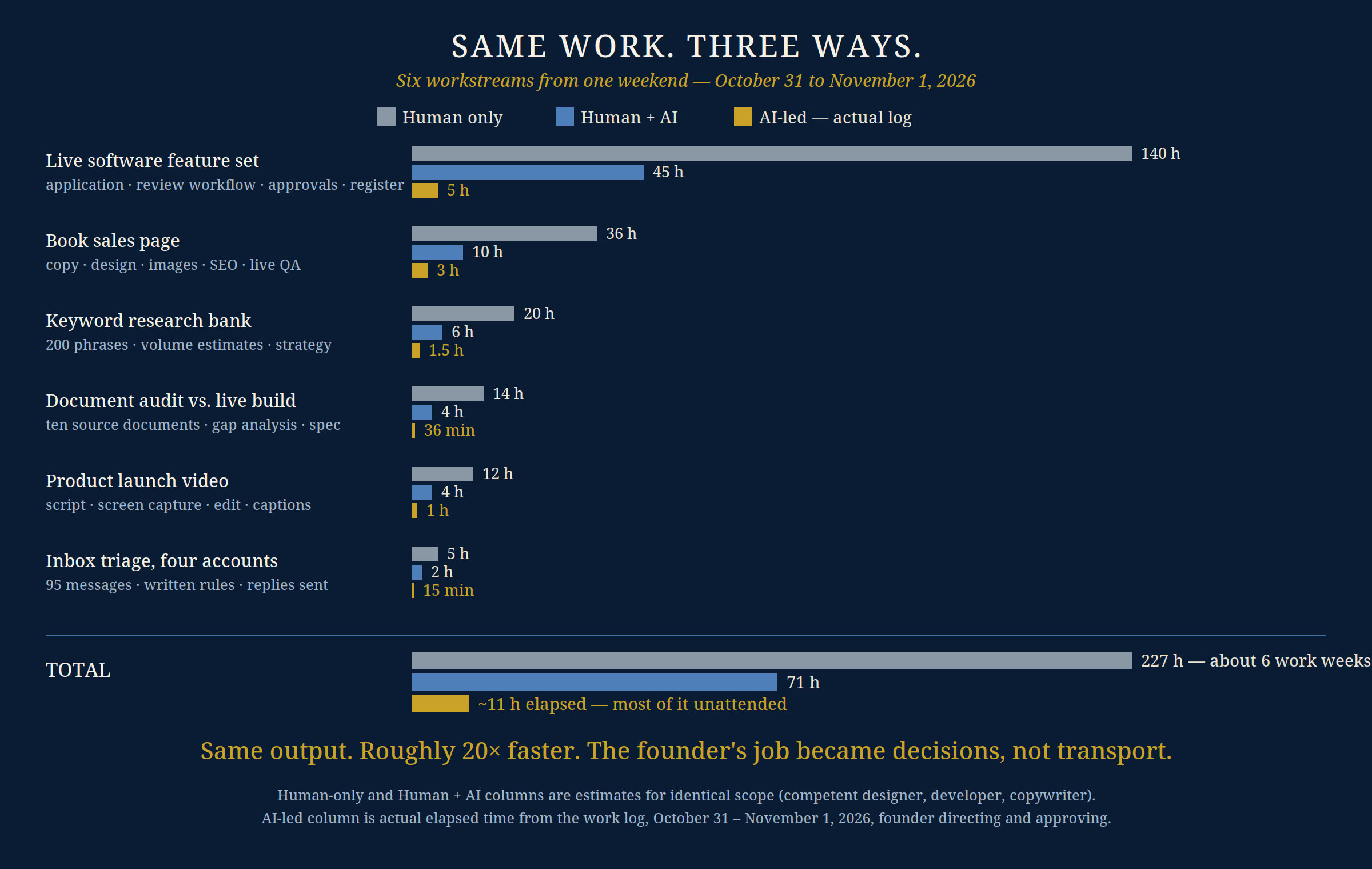
Here's what the last two days actually looked like, measured three ways: what the same work would take a competent human team working alone, what it takes a human directing AI part-time, and what it actually took in our system. The first two columns are honest estimates for identical scope. The third is our work log.

Six workstreams. Roughly 227 hours of conventional effort, compressed into about 11 hours of elapsed build time across two days — and most of those 11 hours, nobody was sitting in front of them. The work ran while I was at dinner, at church, asleep. My personal time in the whole two days was a few hours of decisions, most of them one-word answers from my phone.
What I do now
Tonight, a Sunday, the pattern ran end to end one more time. A question came up about whether the data feeds behind our dashboard were healthy. The architect specified how to check. The chief of staff got herself access to the server — I approved one setting from my phone; that was my entire contribution — ran the checks, and carried the results back. Meanwhile a standing weekly audit is set to run at 2:00 AM tonight so Monday's 7:30 meeting starts with verified numbers instead of surprises.
That's the whole thesis of my book, applied to my own calendar: your business works — the question is whether it works without you standing in the middle of it. Most owners don't have a tools problem. They have a routing problem, and the router is them.
Remove the router. Keep the judgment.
— Brett Payne, 10X Enterprises
The Franchise Freedom Blueprint — the book behind the bottleneck framework — is at 10xenterpriseshq.com/book.
Frequently asked questions
What does it mean to be the integration layer between your own AI tools?
Every tool can only talk to you, so your day becomes copying answers from one window, pasting them into another, and re-explaining context. You stop leading the system and become its slowest, most error-prone component.
What roles does an AI org chart need?
A chief of staff who holds the whole picture and drives the work, an advisor whose job is to argue with the first draft, one architect per project as the single system of record, builders that write the code, and a machine room plus ledger — servers keeping data current and one repository every change passes through.
What rules make a multi-AI system reliable?
Relay verbatim between seats instead of summarizing. Keep one quarterback per project. Verify every change on the live product before calling it done. Put authority — who may merge, publish, and spend — in writing. And the founder does judgment, never transport.
How much time can this approach actually save?
In the two days documented in the article, six workstreams that would take an estimated 227 hours of conventional effort were completed in about 11 hours of elapsed build time. The conventional figures are honest estimates for identical scope; the 11 hours is the actual work log.