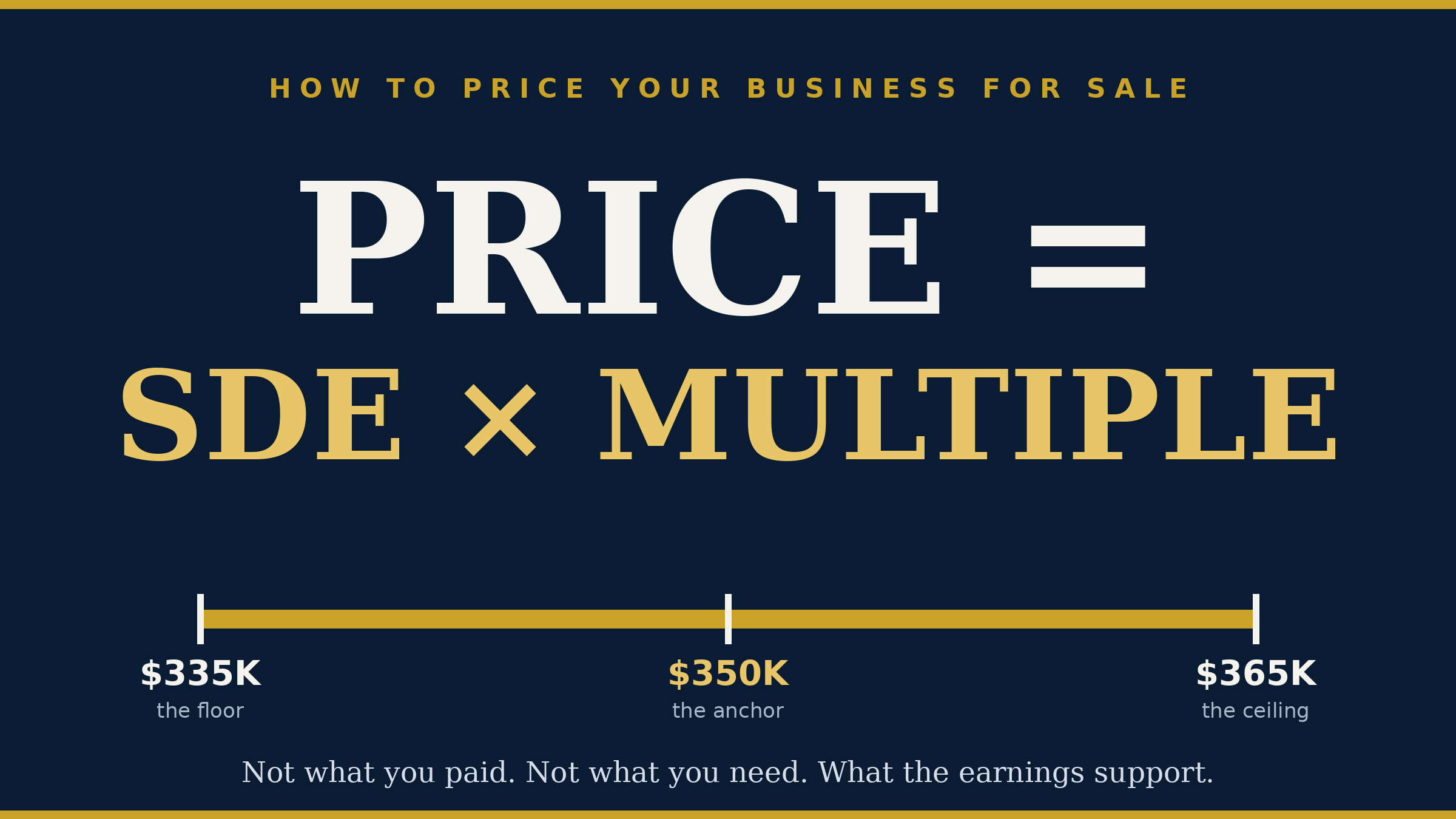
For several years I priced franchise resales for a living — regional vice president work at United Franchise Group, evaluating signage and printing franchises whose owners were ready to exit. The sellers were good operators. Almost none of them knew what their business was worth, and the number they'd arrived at on their own was almost never a number a buyer — or a buyer's lender — would accept.
This is the exact method I used, the same one on every file. It isn't complicated. It's just honest, and it removes the emotion that wrecks most asking prices.
The short version
Your business is worth a multiple of its SDE — Seller's Discretionary Earnings: the total financial benefit one owner-operator takes out of the business in a year. Build the SDE from three years of financials. Audit every add-back like a buyer will. Multiply by 2 to 3, depending on which side of the table you're on and which way the earnings are trending. If it's a franchise, add the transfer fee. Then present a range, never a single price — because buyers and lenders run this same math, and a price the math can't support doesn't survive first contact with either of them.
Step 0: Clean books, or nothing else matters
You cannot do any of this without clean P&Ls — and nobody is buying your business without them anyway. So the real first step happens at your accountant's office: three years of profit-and-loss statements and tax returns, cleaned up, every personal item identified, everything reconcilable. Sellers who skip this step don't get a higher price. They get no price, because the deal dies in underwriting. Clean books first. Then the math.
Step 1: Gather three years, not one story
One good year is a story. Three years is evidence. Before I calculated anything, I required:
- Three years of P&Ls and tax returns, plus trailing-twelve-months figures
- The owner's actual discretionary items — salary, perks, the vehicle the business leases for them
- Staffing detail and the owner's own hours (how much of this business is the owner?)
- Lease terms: rent, remaining term, square footage
A business is priced on its pattern, not its best year.
Step 2: Build the SDE
The formula:
SDE = Net Profit + Owner Salary & Compensation + Owner Perks & Discretionary Expenses + Depreciation + Interest + One-Time / Non-Recurring Expenses
Here's a real store's 2024, anonymized — a mature signage franchise in the Southwest doing roughly $770,000 a year in revenue:
| Line | Amount |
|---|---|
| Taxable income (net profit) | $19,465 |
| Officer compensation | $92,000 |
| Depreciation | $4,857 |
| Interest | $2,668 |
| SDE, 2024 | $118,990 |
Do the same build for all three years:
| Year | SDE |
|---|---|
| 2022 | $144,618 |
| 2023 | $127,672 |
| 2024 | $118,990 |
| Three-year average | $130,427 |
Two things to notice. First, the taxable income looks tiny — $19,465 — because the owner's real compensation runs through the business. That's normal for owner-operated companies, and it's exactly why SDE exists. Second, the trend is down, three years running. The rule I used: take the three-year average — unless the trend is declining, in which case the most recent year gets the weight, because that's the business the buyer is actually purchasing. A declining trend also caps the multiple. We'll come back to that.
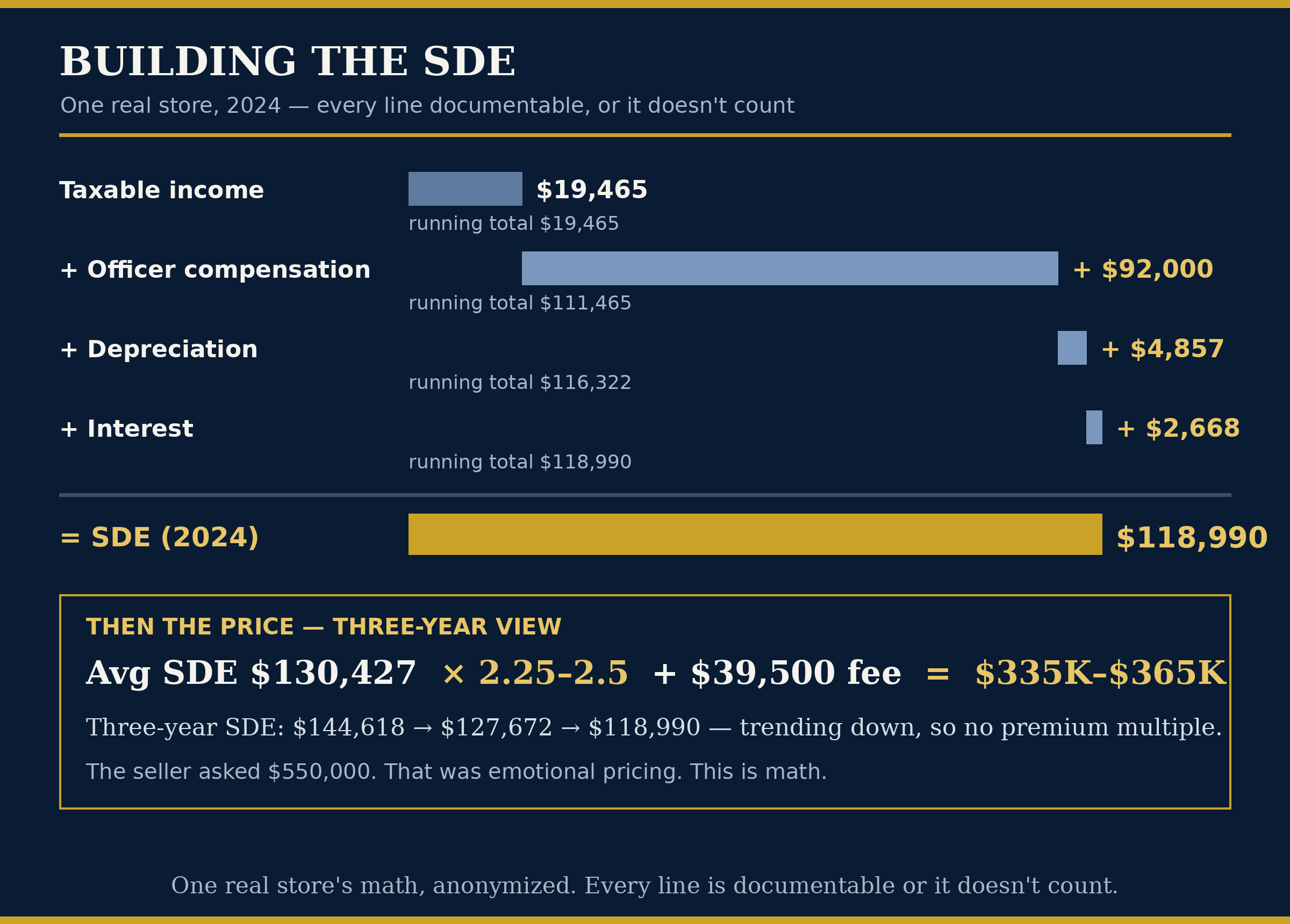
One real store's math, anonymized. Every line is documentable or it doesn't count.
Step 3: Audit the add-backs like a buyer will
This is where sellers lose credibility, and credibility is price. Add-backs are legitimate — owner salary, owner benefits and perks, personal expenses run through the business, depreciation, amortization, interest, genuine one-time costs. In one file I audited line by line, the defensible add-backs came to about $1,300 beyond the owner's comp and the standard items. Everything else the seller wanted to add back was a real operating expense wearing a costume.
What never counts:
- Legitimate operating expenses, relabeled
- Projected or future earnings
- "What the buyer could earn" with better marketing / longer hours / more effort
- Goodwill, reputation, or your years of work — unless they're already inside the earnings
Every illegitimate add-back you claim teaches the buyer to discount everything else you say. Build the SDE you'd defend in front of a lender, because you will be.
Step 4: Apply the multiple — and know what moves it
In the franchise-resale work I did, there were two honest views of the same business:
- Seller's view: 2.0× to 2.5× SDE
- Buyer's view: 2.5× to 3.0× SDE
That gap is deliberate, and here's the part nobody tells either side. I set the seller's expectation at the lower band and the buyer's at the higher one, so the buyer's expectation was to pay more than the seller expected to accept. Each side came to the table braced for the other's number, and deals closed in the overlap instead of dying over a gap neither side understood. I never told either party that's what I was doing. I'm telling you, because if you know the overlap exists, you can negotiate toward it instead of away from it.
Those bands aren't folklore, either. Closed-sale data puts the all-business average at 2.58× SDE (BizBuySell, thousands of reported sales), with wide variation by industry:
| Sector | Average SDE multiple |
|---|---|
| Online & technology | 3.28× |
| Automotive | 3.10× |
| Manufacturing | 3.04× |
| Retail | 2.63× |
| Service businesses | 2.61× |
| Pet services | 2.59× |
| Financial services | 2.46× |
| Food & restaurants | 2.27× |
| Transportation & storage | 1.95× |
| All businesses | 2.58× |
Some formats run far richer — car washes around 4.7×, laundromats around 4.1× — and size matters: businesses selling under $1M average closer to 2.3×, while deals over $1M average around 3.7×. Your industry and your size set the band. What moves you inside it:
Up: growth (accelerating earnings are the only real premium fuel), an owner who works part-time rather than being the business, a lease with runway, staff who stay through a transition, equipment with life left.
Down: a declining trend, thin taxable income, aging equipment (watch the depreciation line — very low depreciation on old equipment is a tell), a lease about to expire, and liens, which have to be paid off before a transfer can close, usually out of the sale proceeds.
Back to our store: mature, decent revenue, earnings trending down three straight years. My call was 2.25× to 2.5× — the middle of the seller's band. Could it earn 2.75× if growth was accelerating? Sure. It wasn't.
Step 5: Add the transfer fee, round, and price a range
A franchise resale carries a cost a non-franchise sale doesn't: the franchisor's transfer fee — in the system I worked in, $39,500 standard. It goes on top of the earnings value, because the buyer is paying it to own the business at all:
- $130,427 × 2.25 = $293,461
- $130,427 × 2.5 = $326,067
- Plus the $39,500 transfer fee: $332,961 to $365,567
Rounded, my professional opinion on that store: it sells between $335,000 and $365,000, anchored around $350,000. Much above $370,000 and SBA debt coverage gets tight — a lender stress-tests the payment against the earnings, and the earnings stop cooperating.
The seller's ask? $550,000. That was not financial pricing. It was emotional pricing — what he'd put in, what he felt he deserved, what he needed the number to be. Emotional pricing only works when there's explosive growth, exceptional assets, or unique strategic value. This store had none of the three. It had good earnings and a fair range, and the fair range is what it was worth.
The mistakes I saw on repeat
- Pricing on what you paid — or worse, on what a new franchise costs to open. A new location's price buys a territory and a start date. A resale buys earnings. Buyers pay for the second thing.
- Pricing on revenue. A $770,000 store with $119,000 of SDE is not a $500,000 business, no matter how impressive the top line sounds at dinner.
- Pricing on your years. "I built this for 25 years" is true, and it matters — to you. The buyer is purchasing the next owner's earnings, not your last 25 years. This is the hardest sentence in every valuation conversation, and it's the one that has to land.
- Inflating the SDE with operating expenses and projections, then acting surprised when the lender's version comes back lower.
- Ignoring the floor case. I ran this math once and the honest SDE came back negative — a small net loss and only about $1,300 of legitimate add-backs. There is no multiple of a negative number. The earnings value was zero; the buyer covered the transfer fee; goodwill was worth somewhere between nothing and $5,000. If that's your file, the move is to fix the earnings for a year and then sell — or sell the assets and the head start honestly, at an asset price.
What can add value beyond the earnings
The multiple prices the earnings. It doesn't price everything, and pretending otherwise undersells some businesses:
- Equipment and FF&E at real fair-market value — actual, appraised, still-useful assets support the top of the range.
- Saleable inventory — stock a buyer would have had to purchase anyway.
- Transferable contracts and recurring revenue — agreements that survive the sale are worth money because they de-risk the buyer's first year.
- A documented customer list — not a price line of its own, but part of why a buyer pays the high end of the band instead of the low end.
- A manager already in place — the single biggest reducer of "job purchase" discount.
- Lease position — below-market rent or years of runway left is real, transferable value.
Notice what's not on the list: your effort, your history, your sacrifice. Those built the earnings. The earnings are what sells.
Where to sit inside your range
I never dictated a price to a seller — it's their business and their call. What the math gives you is the honest band. Price toward the low end and you typically get faster interest and a cleaner negotiation. Price toward the high end and you keep room to negotiate, at the cost of time on the market and the downward adjustments that come with it. Price above the band and you're not negotiating anymore — you're waiting for a buyer who doesn't do math, and lenders weed those out.
The fifteen-minute version
- Clean books first — three years of P&Ls and tax returns your accountant has reconciled.
- Build SDE for each year: net profit + owner comp + perks + depreciation + interest + one-time items.
- Average the three years — or weight the latest year if earnings are declining.
- Multiply by your industry's band (all-business average: 2.58×; franchise resales: 2.0–2.5× seller's view, 2.5–3.0× buyer's view).
- Add the transfer fee if it's a franchise. Round. Price the range, not a point.
Or run the whole thing in the calculator — it does this exact math, including the trend check and the fee.
That's the whole method. It won't tell you what you want to hear. It will tell you what a buyer, a broker, and a bank are all going to conclude from the same financials — and it's a lot easier to negotiate from a number you can defend than from one you have to explain.
— Brett Payne